EDI and SICS
The Reinsurance market increasingly uses electronic methods to transfer data between business partners. This not only increases the speed at which data can be transmitted but also improves accuracy by avoiding hand written documents. High volumes of transactions can be simply and efficiently distributed using EDI (Electronic Data Interchange) messages, and SICS includes an EDI interface to allow you to receive and validate them. If a message checks out, then it can automatically update SICS.
There are two main types of EDI messages in Europe: Joint Venture (JV,) where messages can be sent directly between business partners, and London Insurance Markets network (LIMNET) messages, which are distributed centrally by the London Processing Centre on behalf of a bureau. A typical example of London EDI data is when the bureau sends a batch of signing messages, each of which will create and close a technical worksheet in SICS
P&C support the LIMNET messages as listed in the table in Find EDI Messages, as well as messages from the Dutch Insurance Exchange Association (VNAB) which are detailed in the Processing EDI VNAB Messages section of thischapter.
In LIMNET EDI, P&C can process CLASS messages (for claims), signings and settlements. It can also load the Lloyds Monthly control message, which is held in the EDI archive for information only.
Receiving EDI Messages in SICS #
In order for EDI to work, the company sending you batches of messages must comply with the JV and LIMNET market standards.
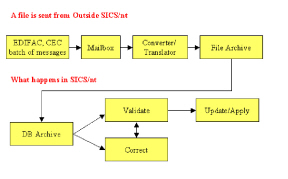 SICS accepts EDIFACT standard messages, CEC format and XML (dependent on bureau.) When you receive a batch of EDI messages, you receive a file directly to your mailbox, or, you might receive a file in another format. (Refer to the illustration above.)
You can select which batches to read, archive, and process.
For each batch, SICS goes through an automatic validation process. The first part is at the batch level and the second at the message level and occurs for each message in the batch. If both processes are successful, and the message is supposed to update SICS, then the message updates SICS. If the first validation process failed, you can do a search for the batch and correct the mistake(s) so that the batch can be processed properly. An example of this is a LIMNET batch that is out of sequence.
If the second validation process failed, you can search for the message error and correct the mistake(s) so that the message can be processed properly. For example, if there is a misspelling of a member reference to the business, the reference can be corrected.
Sending EDI Messages from SICS #
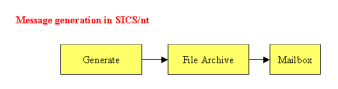
SICS provides the possibility to produce JV messages. These messages can then be sent between business partners without the need of an intermediary entity as required for LIMNET.